Dashcam Footage Privacy on Public Roads: 2026 Guide
Dashcam Footage Privacy on Public Roads: 2026 Guide
TL;DR:
- Dashcam footage recording on public roads is legal in all 50 US states, but audio recording often requires all-party consent. Violating audio laws or mishandling footage can lead to criminal penalties or privacy violations, especially under EU GDPR rules. Drivers should disable audio, verify consent requirements, and store footage securely to remain compliant and protect their legal interests.
Dashcam footage privacy on public roads is defined as the legal and ethical framework governing what drivers may record, store, and share while operating a vehicle. Video recording on public roads is legal in all 50 US states, protected under the First Amendment’s right to record in public spaces. Audio recording is a different matter entirely. Twelve states require all-party consent before capturing sound inside a vehicle, and violating those rules can trigger criminal penalties. Understanding where the line falls between lawful documentation and privacy violation is the first step toward using your dashcam with confidence.
What is dashcam footage privacy on public roads?
Dashcam footage privacy refers to the rules that determine who can record, who has rights over that footage, and what can legally be done with it. On public roads, the general principle is straightforward: you have no reasonable expectation of privacy when you are visible in a public space. Courts have consistently upheld this position under the First Amendment.

That said, the legal picture is not uniform. The distinction between video and audio recording is the most important one for drivers to understand. Video captures what is visible to anyone on the road. Audio captures private conversations inside a vehicle, which courts treat very differently.
Leading dashcam brands, including Garmin and Vantrue, default their devices to audio off. That default exists precisely because of the legal risk audio recording creates. If you drive through California, Florida, or Illinois with your microphone on and a passenger in the car, you may be breaking the law without realizing it.
How do state-level laws affect dashcam audio and video recording?
Video recording is legal across all 50 states for public road use. No state prohibits a driver from mounting a camera and recording the road ahead. Audio recording is where state law diverges sharply.
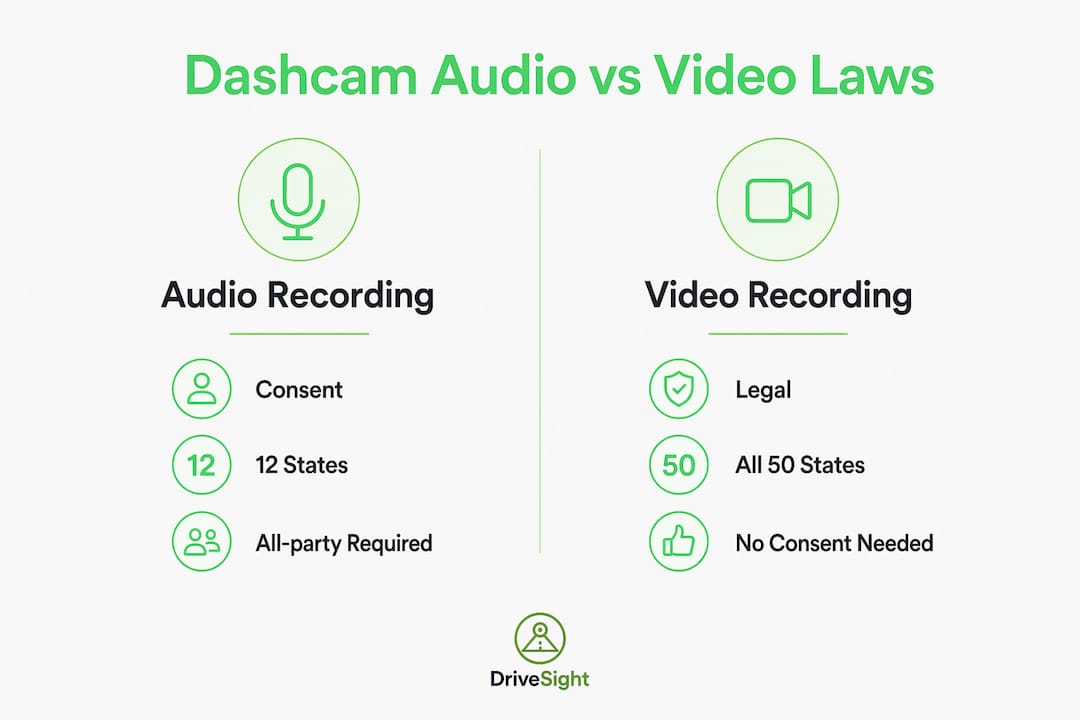
Twelve states require all-party consent for audio recording. Those states are California, Connecticut, Florida, Illinois, Maryland, Massachusetts, Michigan, Montana, Nevada, New Hampshire, Oregon, Pennsylvania, and Washington. Recording a passenger’s voice in any of these states without their knowledge is a wiretapping violation, not just a civil matter.
Practical implications for drivers include:
- Disable audio by default. If you regularly carry passengers or drive through multiple states, turn the microphone off permanently.
- Notify passengers in consent states. A simple verbal notice before a trip satisfies the consent requirement in most jurisdictions.
- Check your route. Long-distance drivers crossing state lines should know which states along their route require all-party consent.
- Review cloud storage obligations. Cloud-compatible dashcams expose drivers to data subject rights requests under state comprehensive privacy laws. Local storage avoids most of those obligations.
Pro Tip: If you use a smartphone as your dashcam, check the app settings before every trip to confirm the microphone is disabled. Many apps reset audio settings after an update.
Check the dashcam laws by state breakdown for a full list of consent requirements and mounting rules across all 50 states.
| State | Audio consent required | Video recording legal |
|---|---|---|
| California | All-party | Yes |
| Florida | All-party | Yes |
| Illinois | All-party | Yes |
| Texas | One-party | Yes |
| New York | One-party | Yes |
What are the dashcam privacy rules in the EU and internationally?
Outside the US, dashcam footage privacy laws are significantly stricter. The EU’s General Data Protection Regulation treats identifiable dashcam footage as personal data the moment it captures a recognizable face or license plate. That classification triggers a full set of data protection obligations.
Sharing dashcam footage online in the EU without anonymizing faces and plates is a GDPR violation. Countries like Austria and Portugal enforce stricter national rules on top of GDPR, and some restrict systematic public road recording entirely.
Key points for EU drivers and anyone sharing footage internationally:
- The household exemption applies only to purely personal, non-commercial use. Rideshare drivers and delivery operators cannot rely on it.
- Commercial dashcam users must provide written notification to passengers about recording, data collection, and retention policies.
- Publishing footage on social media without blurring identifiable information can result in regulatory fines.
- Storing footage on EU-based cloud servers subjects that data to GDPR access requests from individuals who appear in the video.
The contrast with US law is significant. In the US, recording a stranger’s license plate on a public road raises no legal issue. In Germany or France, that same footage becomes regulated personal data the moment it is stored or shared.
What legal risks should drivers avoid with dashcams?
The most common legal mistake drivers make is recording audio without consent. All-party consent violations can result in criminal charges under state wiretap statutes, not just civil liability. Disabling the microphone is the single most effective way to avoid this risk.
Beyond audio, several other legal pitfalls deserve attention:
- Targeting private property. Incidental recording of a neighbor’s driveway while driving past is generally legal. Parking outside a private residence and recording it deliberately is not. Courts distinguish passive road recording from intentional surveillance.
- Biometric data collection. Dashcams with driver monitoring features, such as facial recognition or eye-tracking, trigger laws like the Illinois Biometric Information Privacy Act (BIPA). Biometric data violations carry severe financial penalties per incident, not per case.
- Handheld recording. Holding a smartphone to record while driving qualifies as distracted driving in many states. The legality of recording does not extend to the method. A fixed mount is legally required in most jurisdictions.
- Rideshare and commercial use. Uber and Lyft drivers cannot rely on personal-use exemptions. They must post visible notices about recording and comply with applicable data protection rules.
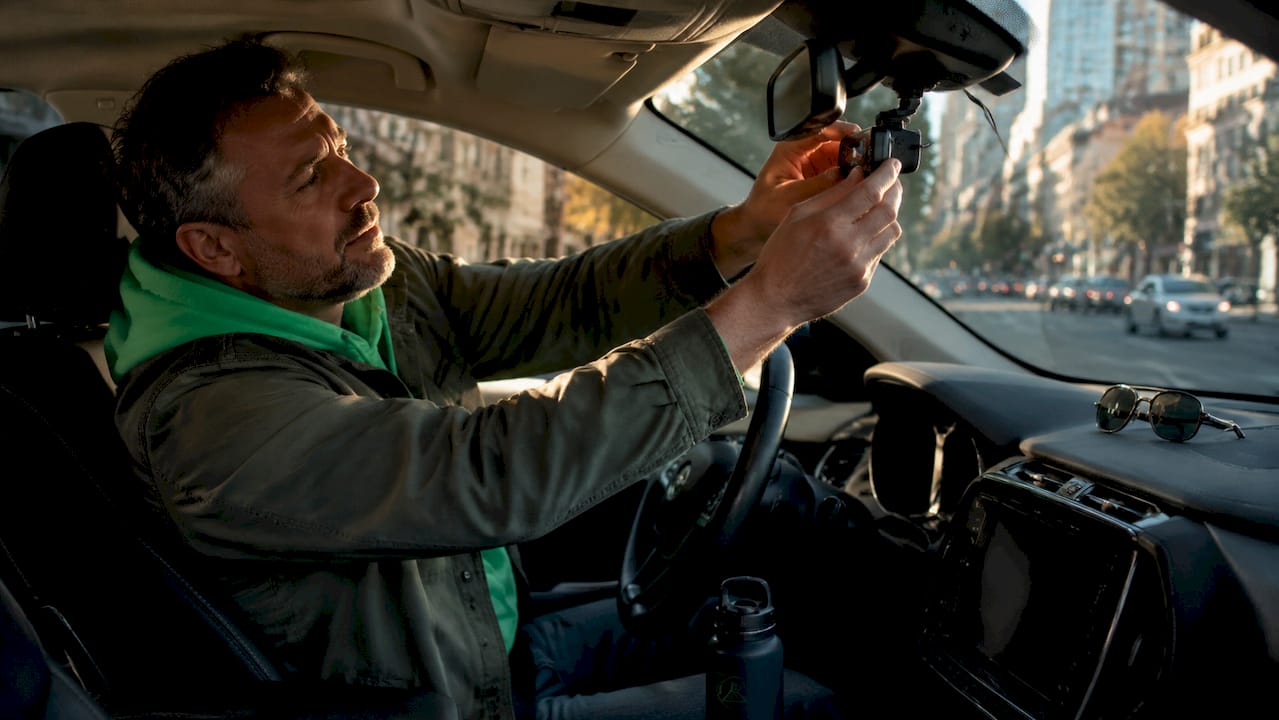
Pro Tip: Mount your phone or dashcam on a fixed windshield or dashboard mount before you start driving. Never adjust the camera while the vehicle is moving. This single habit protects you from both distracted driving citations and footage setup mistakes that ruin your recordings.
How can dashcam footage be used legally as evidence?
Dashcam footage is admissible in court when it meets specific legal standards. Footage must be authenticated, unaltered, and preserved with a clear chain of custody. Original files with intact metadata carry far more evidentiary weight than copies or edited clips.
Footage can be subpoenaed in both civil and criminal cases. If you are involved in an accident, law enforcement or opposing counsel can legally request your recordings. Deleting footage after an incident can be treated as destruction of evidence, which creates serious legal exposure.
Follow these steps to manage footage legally and effectively:
- Save incident clips immediately. Use your dashcam’s manual save or crash detection feature to lock footage as soon as an event occurs.
- Keep original files untouched. Never edit, trim, or apply filters to footage you may need as evidence. Work from copies only.
- Document the chain of custody. Note the date, time, and device used when you save or transfer footage. This matters in court.
- Use local storage for sensitive recordings. Local storage devices avoid the data subject rights obligations that cloud solutions create. For guidance on managing files effectively, the storage strategies for Android users guide covers backup and retention best practices.
- Share footage only with trusted parties. Provide copies to your insurer, your attorney, or law enforcement. Posting footage publicly before a legal matter is resolved can complicate your case.
| Footage use case | Key requirement |
|---|---|
| Insurance claim | Original file, unedited, with timestamp |
| Civil litigation | Chain of custody documentation |
| Criminal proceeding | Authentication and metadata integrity |
| Law enforcement request | Comply promptly; retain your own copy |
Fleet managers and commercial operators have additional obligations. The fleet dashcam evidence best practices guide covers retention policies, employee notification requirements, and secure handoff procedures in detail.
Key Takeaways
Dashcam video recording is legal on all US public roads, but audio consent laws and data protection rules in 12 states and the EU create real legal risk for drivers who record without checking local requirements first.
| Point | Details |
|---|---|
| Video is legal everywhere in the US | All 50 states permit dashcam video recording on public roads without restriction. |
| Audio requires all-party consent in 12 states | Disable the microphone by default if you drive in CA, FL, IL, or any other consent state. |
| EU footage is regulated personal data | GDPR applies to any footage with identifiable faces or license plates; anonymize before sharing. |
| Biometric dashcams trigger separate laws | Driver monitoring features require explicit consent under statutes like Illinois BIPA. |
| Original footage protects your legal rights | Keep unedited files with intact metadata; editing or deleting footage can damage your case. |
The privacy risk most drivers overlook
Most dashcam articles focus on whether recording is legal. The more pressing question is whether you are handling the data correctly after you record it.
We have seen drivers share dashcam clips on social media within hours of an accident, thinking they are helping their case. In practice, public posting can expose you to GDPR complaints if you are in Europe, complicate insurance negotiations, and give opposing counsel access to footage before your attorney has reviewed it. The recording itself was legal. The sharing was not handled well.
The biometric angle is the one that surprises people most. If your dashcam app includes a driver-facing camera with fatigue detection or eye-tracking, you may be collecting biometric data on yourself and any passenger who sits in the front seat. Illinois BIPA does not care whether you are a commercial operator or a private driver. If you collect biometric identifiers without proper notice and consent, you are exposed.
Our honest recommendation is to treat dashcam footage the way you treat medical records. Store it locally when possible, share it only when necessary, and never post it publicly without legal advice. The footage is your protection. Mishandling it turns it into a liability.
— Cyberlab Automation
How DriveSight supports privacy-compliant dashcam recording
DriveSight’s Phone Dashcam app is built with privacy compliance as a core design principle, not an afterthought. Audio recording defaults to off, which keeps you compliant with all-party consent laws in California, Florida, Illinois, and the other nine consent states without any manual configuration. Footage is stored locally on your Android device by default, avoiding the cloud data subject rights obligations that affect drivers using connected dashcam hardware.
The app also supports secure footage review through the remote viewer tool, letting you access and manage recordings without exposing files to third-party servers. For drivers who want full-featured recording, AI detection, and privacy-first defaults in one place, DriveSight delivers a practical solution that works on the phone already in your pocket.
FAQ
Is dashcam footage legal to record on public roads?
Dashcam video recording is legal in all 50 US states on public roads. Audio recording requires all-party consent in 12 states, including California, Florida, and Illinois.
Does dashcam footage invade privacy?
Recording in public spaces does not invade privacy under US law, since people have no reasonable expectation of privacy on public roads. Deliberately targeting private property or recording audio without consent can cross into illegal territory.
Can dashcam footage be used in court?
Dashcam footage is admissible as evidence when it is authentic, unedited, and preserved with a clear chain of custody. Editing or deleting footage before a legal proceeding can seriously damage its evidentiary value.
What are the dashcam privacy rules under GDPR?
In the EU, dashcam footage with identifiable faces or plates is classified as personal data under GDPR. Sharing it online without anonymizing that information is a privacy law violation.
Do rideshare drivers have extra dashcam obligations?
Rideshare and commercial drivers cannot rely on household exemptions and must post visible notices about recording, data collection, and retention policies for passengers.
Recommended
- Dashcam Laws by State 2026: All 50 States Explained
- Road Trip Dashcam Footage Tips for Memorable Drives
- How a Dashcam Records Border Crossing Footage
- Why Dashcam Footage Proves Fault in Parking Lots
Get Phone Dashcam free
Loop recording, crash detection, GPS tracking, and AI object detection — all in your phone. No new hardware required.
Download Phone Dashcam