The Role of AI in Dashcam Alerts: A Driver's Guide
The Role of AI in Dashcam Alerts: A Driver’s Guide
TL;DR:
- AI in dashcam alerts utilizes on-device neural networks to analyze live video and provide real-time safety warnings before incidents occur. This technology enables rapid, predictive detection of risky behaviors and hazards, improving driver response and trust through filtered false alerts. Integration with driver coaching workflows and innovative features like collision prediction and interior monitoring enhances overall fleet and personal vehicle safety.
AI in dashcam alerts is defined as the use of on-device machine learning models to analyze live video and sensor data, then deliver real-time safety warnings before an incident occurs. This is a fundamental shift from passive recording to active safety intervention. Traditional dashcams capture footage after the fact. AI-powered dashcam solutions like Nexar BADAS 2.0 and Nextbase iQ Pro analyze what is happening right now and warn you in time to act. The role of AI in dashcam alerts is not just faster recording. It is predictive, context-aware protection that responds in milliseconds to distracted driving, tailgating, lane departure, and more.
How does AI technology detect risky driving behaviors in dashcam alerts?
The technical foundation of AI dashcam alerts is Edge AI, which means the artificial intelligence runs directly on the dashcam hardware rather than sending data to a remote server. On-device Edge AI enables dashcams to deliver in-cab alerts within 200 milliseconds of detecting risky behavior like distracted driving or tailgating. That speed matters because a vehicle traveling at 60 mph covers 17 feet in 200 milliseconds. Cloud-only systems cannot match that response time due to network latency.
The detection itself relies on neural networks, specifically convolutional neural network architectures similar to YOLOv8, trained on millions of real-world driving events. These models identify specific behaviors and objects in each video frame:
- Distracted driving: Eyes off the road, phone use, or head position deviating from forward gaze
- Driver fatigue: Microsleep episodes, slow blink rates, and head drooping
- Tailgating: Calculated following distance below safe thresholds using object depth estimation
- Lane departure: Vehicle position relative to detected lane markings
- Harsh braking and acceleration: Combined with accelerometer data for confirmation
- Road hazards: Pedestrians, cyclists, and animals entering the vehicle’s path
Higher-level spatial awareness models go further. Filtering false positives through these models reduces alert fatigue compared to cloud-processed dashcams, because the system distinguishes a roadside sign from a pedestrian stepping into traffic. That distinction is what separates a useful alert from an annoying one.
Pro Tip: When evaluating any AI dashcam or dashcam app, ask specifically whether the AI runs on-device or in the cloud. If the answer is cloud-only, the system cannot reliably deliver sub-200ms alerts, which limits its real-time safety value.
What benefits do AI dashcam alerts offer over traditional dashcams?
The clearest advantage is timing. A standard dashcam records an accident. An AI dashcam warns you before the accident happens. Nexar’s BADAS 2.0 predicts collisions nearly 5 seconds in advance by analyzing live video, trained on over 2 million real-world events with 99.4% average precision. Five seconds is enough time for a driver to brake, steer, or sound the horn.
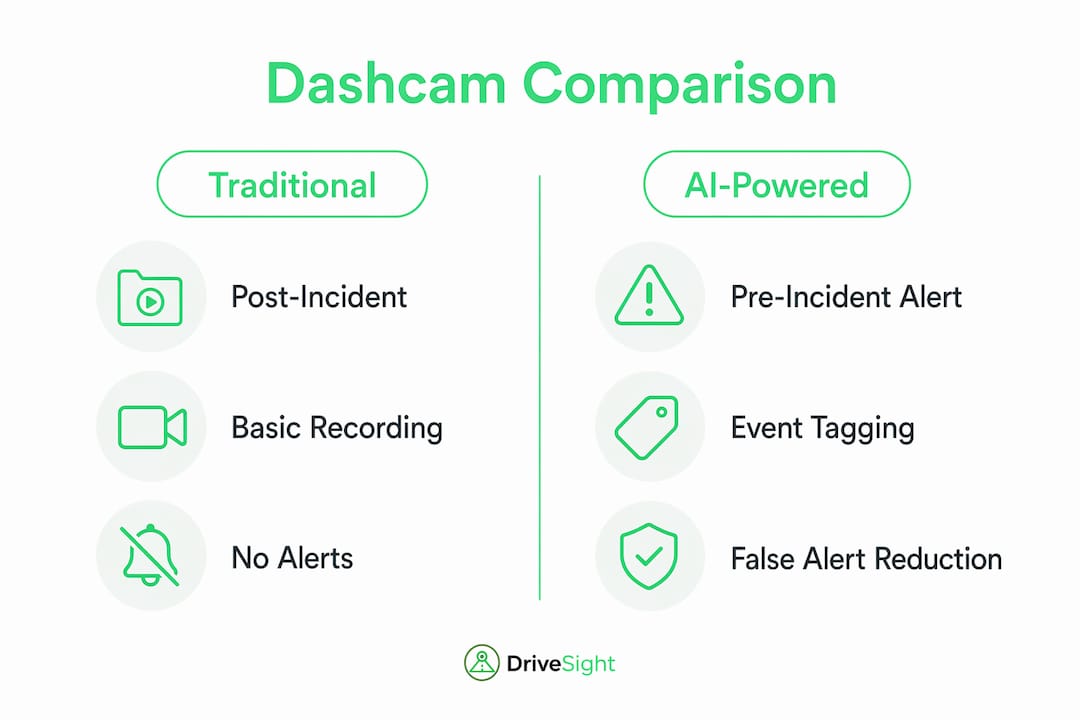
Beyond collision prediction, AI dashcam technology automatically tags every recorded event with GPS coordinates, vehicle speed, and diagnostic data. That context transforms a raw video clip into a complete incident record. For insurance claims, that record is far more credible than untagged footage.
The table below compares traditional dashcams against AI-powered dashcam solutions across the dimensions that matter most to drivers and fleet operators.
| Feature | Traditional dashcam | AI-powered dashcam |
|---|---|---|
| Alert timing | Post-incident recording only | Real-time, pre-incident warnings |
| False alert rate | High (no object differentiation) | Low (spatial awareness filtering) |
| Event tagging | Manual or none | Automatic with GPS, speed, diagnostics |
| Fatigue detection | None | Infrared gaze-tracking and microsleep detection |
| Collision prediction | None | Up to 4.9 seconds ahead (Nexar BADAS 2.0) |
| Insurance value | Basic footage | Context-rich, timestamped incident records |
The reduction in false alerts deserves specific attention. Drivers who receive too many incorrect warnings start ignoring all alerts, including the critical ones. Advanced spatial awareness models address this directly by filtering harmless roadside objects before triggering any notification. The result is a system drivers trust and respond to, rather than mute.
For fleet operators, the benefits extend to insurance premiums and liability protection. AI dashcams that capture rear-end collision proof with full telematics context give insurers the evidence needed to resolve disputes quickly and accurately.
How do AI dashcam alerts integrate with driver coaching and fleet safety?
AI dashcam alerts do not stop at the in-cab warning. The same intelligence that detects a risky behavior also categorizes it, scores its severity, and routes it into a structured coaching workflow. Automated event tagging by severity provides GPS, speed, and vehicle diagnostic data for coaching that is specific and evidence-based rather than general and anecdotal.
The operational impact on fleet managers is significant. Manual safety review time dropped from 4 hours to 45 minutes weekly in documented deployments using AI dashcam workflows. That is not a minor efficiency gain. It means safety managers spend their time on high-severity exceptions instead of watching hours of routine footage.
Here is how a structured AI dashcam coaching workflow typically operates:
- Detection: The dashcam’s neural network identifies a risky behavior and triggers an in-cab alert within 200 milliseconds.
- Recording: The system saves a clip of the event with automatic pre-event and post-event buffer footage.
- Tagging: AI assigns a severity score and labels the event type, GPS location, speed, and time.
- Routing: High-severity events go directly to a safety manager queue. Low-severity events are batched for weekly review.
- Coaching: The manager reviews the tagged clip and delivers specific, evidence-based feedback to the driver.
- Tracking: The system monitors whether the behavior recurs, measuring coaching effectiveness over time.
Integrating AI dashcams with coaching workflows can reduce fleet safety incidents by up to 40%, cutting weekly coaching review time by more than 80%. One fleet reported incident reductions from 12 to 3 over 14 months. Those numbers reflect what happens when AI handles the detection and categorization work, freeing humans to focus on behavior change.
Fleet AI dashcams use multi-trigger automation to handle routine alerts, allowing safety managers to focus on high-severity events. Automated alerts can include hours-of-service violations, excessive idling, and unsafe behaviors. This keeps the system manageable even across large fleets.
Pro Tip: Set your AI dashcam alert sensitivity thresholds carefully during initial deployment. Starting too sensitive creates alert fatigue. Starting too lenient misses real risks. Spend two weeks calibrating before drawing any conclusions about driver behavior.
What are the latest innovations in AI dashcam alert technology?
The most significant recent development is predictive trajectory modeling. Rather than reacting to a hazard already in the vehicle’s path, systems like Nexar BADAS 2.0 analyze the trajectories of surrounding vehicles and pedestrians to forecast where they will be in the next several seconds. That predictive layer is what enables collision prediction nearly 5 seconds ahead, giving drivers a meaningful window to respond.
Interior monitoring has advanced equally fast. Nextbase iQ Pro uses interior-facing infrared sensors and gaze-tracking to detect fatigue and distraction, triggering voice prompts before incidents occur. The system can detect microsleep and phone use without requiring the driver to interact with any interface. The alert arrives as a voice prompt, keeping the driver’s hands on the wheel and eyes on the road.
The table below summarizes the key emerging technologies and their current state of deployment.
| Technology | Function | Current status |
|---|---|---|
| Predictive trajectory modeling | Forecasts collisions 4–5 seconds ahead | Deployed (Nexar BADAS 2.0) |
| Infrared interior monitoring | Detects fatigue, distraction, microsleep | Deployed (Nextbase iQ Pro) |
| Gaze-tracking AI | Monitors eye position and blink rate | Deployed in premium systems |
| 360-degree hazard detection | Auxiliary cameras covering blind spots | Emerging, limited deployment |
| Emergency system integration | Automatic SOS on crash detection | Available via dashcam SOS integration |
| Insurance telematics linking | Real-time data sharing for premium discounts | Pilot programs active |
Blind-spot coverage is the next frontier. Auxiliary cameras mounted at the rear and sides feed additional video streams into the same neural network, allowing the system to detect low-profile hazards like cyclists and motorcycles that a single forward-facing camera would miss. Model accuracy improvements are reducing false positives in these multi-camera setups, making the technology viable for everyday drivers rather than just commercial fleets.
The long-term direction points toward AI dashcams that do not just warn drivers but communicate directly with vehicle safety systems. Automatic emergency braking triggered by dashcam AI, rather than only by proximity sensors, is an active area of development. For personal vehicle owners, the near-term benefit is insurance programs that reward demonstrably safe driving behavior captured and verified by AI dashcam analytics.
Key takeaways
AI in dashcam alerts transforms passive recording into active, real-time safety intervention through on-device Edge AI that detects risks, predicts collisions, and automates driver coaching workflows.
| Point | Details |
|---|---|
| Edge AI is non-negotiable | On-device processing delivers sub-200ms alerts; cloud-only systems are too slow for real-time safety. |
| Prediction beats reaction | Nexar BADAS 2.0 predicts collisions 4.9 seconds ahead, giving drivers time to act before impact. |
| False alert filtering builds trust | Spatial awareness models reduce incorrect alerts, so drivers respond to warnings instead of ignoring them. |
| Coaching integration multiplies value | AI-tagged events cut safety manager review time from 4 hours to 45 minutes weekly. |
| Interior monitoring closes the gap | Infrared gaze-tracking detects fatigue and distraction before any outward incident occurs. |
What most drivers get wrong about AI dashcam alerts
We have spent considerable time working with AI dashcam technology, and the most common mistake we see is treating alert volume as a sign of system quality. More alerts do not mean better safety. A system that fires warnings every few minutes trains drivers to ignore all of them. The balance between alert sensitivity and driver trust is the single most important configuration decision you will make.
The second mistake is assuming cloud connectivity is sufficient. We have tested both approaches. When a network handoff adds even 500 milliseconds to an alert, the practical safety window shrinks from meaningful to marginal. Edge AI is not a marketing term. It is the architectural requirement that makes real-time alerting physically possible.
What most articles skip is the coaching integration piece. Recording risky behavior and alerting the driver in the moment is valuable. But the compounding safety gains come from structured review and behavior change over time. A dashcam that feeds into a fleet safety workflow delivers far more than one that simply records and alerts in isolation.
For personal vehicle owners, the practical takeaway is this: look for AI dashcam solutions that run inference on-device, filter false positives through spatial awareness, and give you access to tagged event footage with telematics context. Those three features separate genuinely useful systems from dashcams that just happen to mention AI in their marketing.
The technology is evolving fast. Predictive trajectory models, interior infrared monitoring, and emergency system integration are moving from fleet-only features to consumer products. Staying informed about these developments now means you will be positioned to adopt them before they become standard.
— Cyberlab Automation
Experience AI dashcam alerts with DriveSight
DriveSight brings AI-powered dashcam alerts to any Android phone you already own. The DriveSight app delivers real-time crash detection, impact alerts, and a live database of over 336,000 speed cameras, red light cameras, and ALPR readers worldwide. On-device processing keeps your data private while keeping alert latency low.
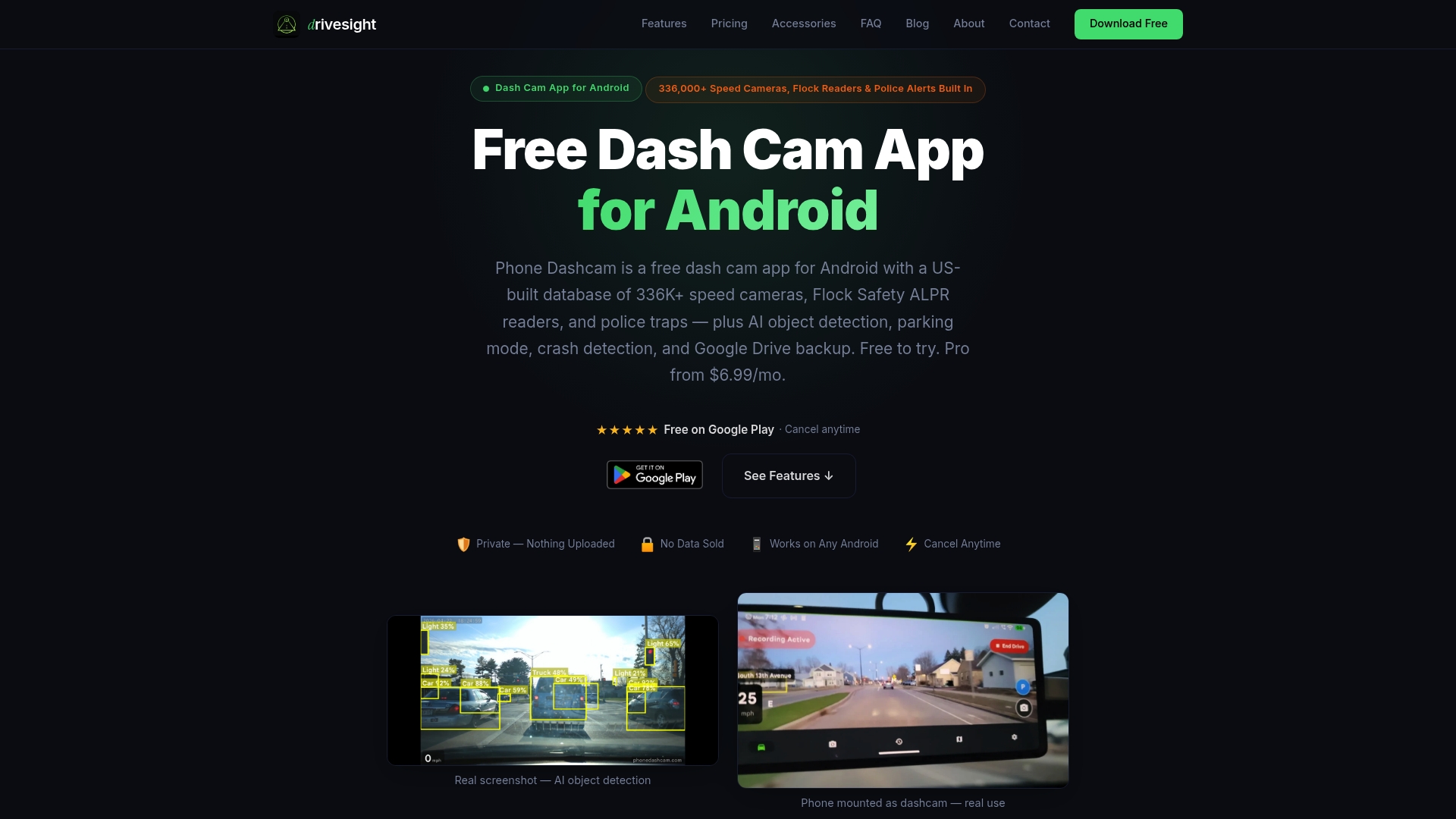
You do not need dedicated hardware. Your phone sitting in the cupholder becomes an active safety system with automatic crash save, motion detection, and cloud backup. DriveSight also supports YOLO AI object detection for vehicles, people and road hazards, bringing the same neural network technology used in commercial fleet systems to everyday drivers. Download the free version and see what your current dashcam setup is missing.
FAQ
What is the role of AI in dashcam alerts?
AI in dashcam alerts uses on-device neural networks to analyze live video and sensor data, then deliver real-time warnings for risky behaviors like tailgating, distraction, and fatigue before an incident occurs. This shifts dashcams from passive recorders to active safety systems.
How fast do AI dashcam alerts respond to dangerous driving?
On-device Edge AI delivers in-cab alerts within 200 milliseconds of detecting risky behavior. Cloud-based systems cannot match this speed due to network latency, making on-device processing the standard for effective real-time alerts.
Can AI dashcams predict collisions before they happen?
Yes. Nexar BADAS 2.0 predicts collisions nearly 5 seconds in advance by analyzing live video trajectories, achieving 99.4% average precision trained on over 2 million real-world events.
How do AI dashcam alerts reduce false warnings?
Higher-level spatial awareness models differentiate actual hazards from harmless roadside objects, filtering out incorrect alerts before they reach the driver. This reduces alert fatigue and keeps drivers responsive to genuine warnings.
Do AI dashcam alerts help with insurance claims?
AI dashcams automatically tag events with GPS coordinates, vehicle speed, and diagnostic data, creating context-rich incident records. That evidence is significantly more credible for insurance claims than untagged footage from a standard dashcam.
Recommended
- Phone Dashcam Blog — Dashcam Guides, App Comparisons & Driving Tips
- Emergency SOS Dashcam Integration: What Drivers Need to Know
- Dashcam Role in Solo Road Trip Safety: 2026 Guide
- The Role of GPS in Dashcam Apps for Drivers
Get Phone Dashcam free
Loop recording, crash detection, GPS tracking, and AI object detection — all in your phone. No new hardware required.
Download Phone Dashcam