DriveSights Are Not What You Think — Why They Actually Work Now
Affiliate disclosure: Some links on this page are Amazon affiliate links. As an Amazon Associate, we earn from qualifying purchases at no extra cost to you.
I get it. You tried using your phone as a dashcam a few years ago and it was awful. The app crashed after 20 minutes. Your phone got so hot you could fry an egg on it. The video looked like it was recorded through a potato. Parking mode? Lasted about 45 minutes before your battery died.
I hear this all the time. People hop on Reddit or Facebook and say "phone dashcams are trash, just buy a real dashcam." And honestly, back in 2019 or 2020, they were mostly right.
But it is 2026 now, and things have changed. A lot.
The phone you have sitting in your drawer right now has a better camera sensor, a faster processor, and smarter software than the $300 dedicated dashcam sitting on Amazon's best seller list. The problem was never the hardware. It was the apps. And the apps finally caught up.
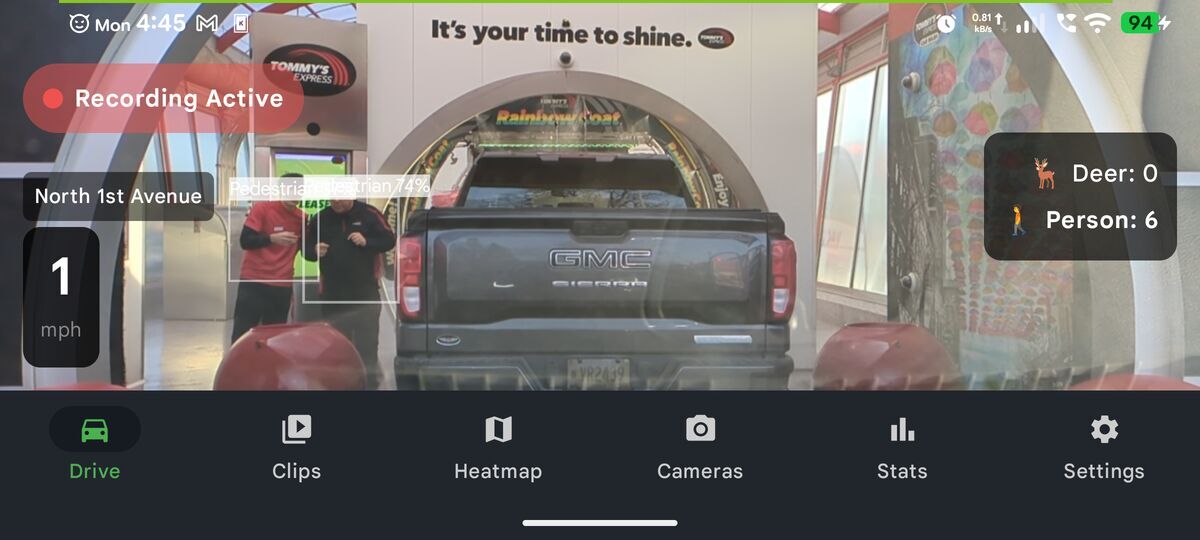
AI object detection running in real-time on an Android phone used as a dashcam
Every Complaint About DriveSights (And What Changed)
Let me go through the biggest complaints one by one, because I have heard all of them. And every single one has a real answer in 2026.
"My phone overheats after 15 minutes of recording"
This was a real issue, especially with flagship phones from 2018-2020. The Snapdragon 845 and 855 ran hot under sustained video recording. Phones would thermal throttle, the camera would shut down, and you were left with nothing.
Modern chips are dramatically more efficient
The processors in phones from the last 3-4 years are built on smaller manufacturing processes (4nm and 5nm) that generate way less heat for the same workload. A Snapdragon 6 Gen 1 in a $200 budget phone handles continuous 1080p recording without breaking a sweat. Even better, budget phones actually run cooler than flagships because they are not pushing as many pixels or running power-hungry features. That old Pixel 4a or Galaxy A52 in your drawer? It handles dashcam recording better than your brand new S24 Ultra because it is not trying to do a hundred other things at the same time. And if you use a vent mount instead of a windshield suction cup, airflow from the AC keeps the phone cool even on hot summer days.
"The battery dies in parking mode"
Older dashcam apps kept the screen on, the GPS running, and the camera recording at full resolution while parked. Your battery went from 100% to dead in under an hour. Completely useless.
Screen-off parking with motion-triggered recording
Modern dashcam apps like DriveSight turn the screen completely off during parking mode and only activate the camera when motion is detected. The app holds a partial wake lock to keep the CPU alive at minimum power while monitoring for movement. When something happens, it records a clip, saves it, and goes back to sleep. A phone with decent battery health runs parking mode for 4-6 hours. If you want all-day coverage, a $15 USB power bank keeps it going indefinitely. That is still cheaper than the $40 hardwire kit a hardware dashcam needs for parking mode.
"The app crashes or stops recording randomly"
Android used to aggressively kill background services to save battery. Your dashcam app would get murdered by the OS 10 minutes after you locked the screen. You would think you were recording and find out hours later that nothing was saved.
Foreground services and proper lifecycle management
Android's foreground service system has matured significantly. A properly built dashcam app now runs as a persistent foreground service with a notification that tells the OS "hey, I am doing something important, do not kill me." Combined with wake locks and sticky service flags, modern apps survive being swiped away from the recent apps list, survive the screen turning off, and even restart automatically if the system kills them. The recording keeps going no matter what. This was a real engineering problem that took years for app developers to solve, and it is solved now.
"The video quality is terrible compared to a real dashcam"
Some early dashcam apps recorded at low resolution to save storage, did not use hardware encoding properly, or produced washed-out video with bad dynamic range. The footage looked like security camera footage from 2005.
Phone cameras are absurdly good now
Let me put this in perspective. The camera sensor in a 4-year-old Google Pixel 4a has better dynamic range, better low-light performance, and sharper autofocus than the Sony STARVIS sensor that premium dashcam manufacturers brag about. Phones have had computational photography for years now, including HDR processing that pulls detail out of shadows and highlights simultaneously. A modern phone recording at 1080p produces footage that is clearer and more detailed than a $250 dashcam recording at 4K, because resolution is not the only thing that matters. Sensor size, lens quality, and software processing matter more, and phones win on all three.
Things Your Phone Can Do That No Hardware Dashcam Can
Here is where it gets interesting. Fixing the old problems was step one. But phones do not just match hardware dashcams now. They blow past them. Here is what you get from a phone dashcam that no dedicated hardware unit offers at any price.
AI Object Detection Running On-Device
Your phone has a neural processing unit (NPU) or GPU that can run real-time machine learning models. DriveSight uses this to run YOLOv8 object detection directly on your phone with zero internet connection. It identifies vehicles, pedestrians, cyclists, and objects on the road in real time. This is the same class of computer vision that self-driving car companies use, running locally on a phone you already own. No hardware dashcam under $500 offers anything close to this.
336,000+ Camera and Police Alerts
Your phone has GPS, a data connection, and a screen. That combination lets a dashcam app show you where every speed camera, red light camera, and police speed trap is before you reach it. DriveSight maps over 336,000 camera locations including Flock Safety ALPR cameras that most people do not even know exist. A hardware dashcam cannot do this because it does not have a cellular connection or the processing power to maintain a live database.
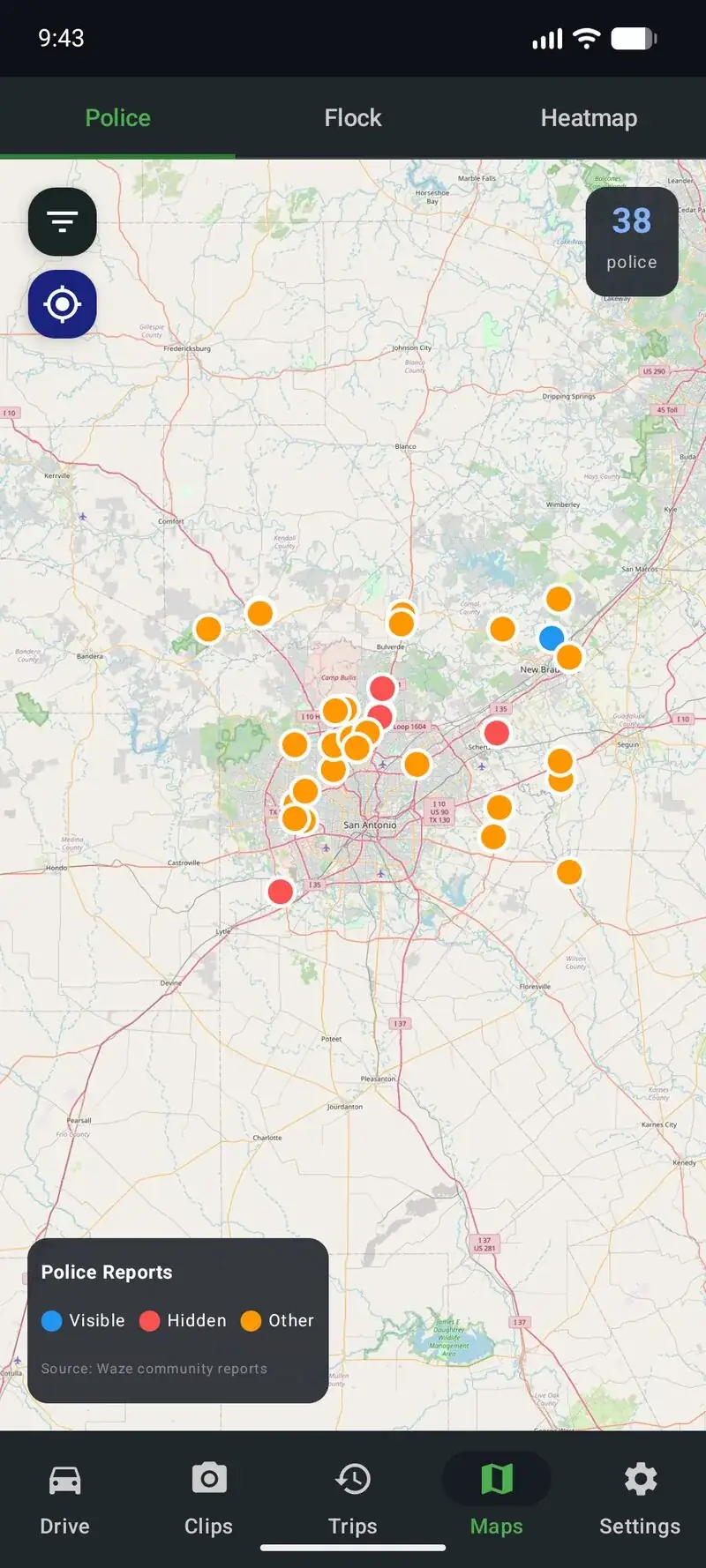
Over 336,000 camera locations mapped and alerting in real-time
Free Cloud Backup
If someone rear-ends you and your hardware dashcam's SD card gets corrupted (which happens more than you would think), your footage is gone. If someone breaks into your car and steals the dashcam, the footage goes with it. DriveSight automatically backs up important clips to Google Drive. Crash clips, parking mode events, and manually saved footage go straight to the cloud. If the phone gets destroyed, stolen, or runs over by a truck, your evidence is already safe in your Google account. Hardware dashcams charge $10-15 per month for cloud features. DriveSight does it for free using the Google Drive storage you already have.
Remote Live Viewing
Want to check on your parked car from your desk? DriveSight streams live video from the dashcam phone to any web browser using WebRTC peer-to-peer video. No relay server, no monthly subscription. Open a link, see your car. Hardware dashcams that offer this charge monthly subscription fees for their proprietary cloud service. Your phone does it for free because it already has WiFi and cellular connectivity built in.
Software Updates That Add Features
Your hardware dashcam gets maybe one firmware update in its entire lifetime, and it probably just fixes a bug. A phone dashcam app gets updated regularly through the Play Store. New features, better performance, new AI models, new camera databases. The dashcam you install today is better next month. Try getting that from a piece of hardware soldered together in a factory.
The Two Honest Advantages Hardware Dashcams Still Have
I am not going to pretend phones are perfect for every situation. Hardware dashcams have two genuine advantages that matter for some drivers.
Extreme Heat Tolerance
If you live in Arizona or Texas and your car sits in a parking lot at 130 degrees all summer, a dedicated dashcam with a supercapacitor handles that environment better than a phone with a lithium battery. Phones have thermal protection that shuts things down when it gets too hot. That said, most drivers in most climates never hit this limit. And if you use a vent mount with the AC running while driving, the phone stays cool even in summer. It is really only the "baking in a parked car in Phoenix" scenario where hardware wins.
Compact Form Factor
A dedicated dashcam the size of a golf ball tucks behind your rearview mirror and is nearly invisible. A phone on a windshield mount is more visible. If discretion matters to you, hardware is more compact. But most people are already mounting a phone on their windshield for navigation anyway, so adding dashcam functionality to it is not exactly a radical change.
That is the complete list. Two advantages. Everything else favors the phone.
The Real Reason People Think DriveSights Are Bad
Most of the negative opinions about phone dashcams come from people who tried a bad app 3-5 years ago and never looked back. And I do not blame them. The Play Store in 2020 was full of low-effort dashcam apps built by developers who clearly never tested them in an actual car. They were basically glorified camera apps with a record button and a timestamp. No loop recording management, no background service handling, no crash detection, no parking mode. They crashed, they overheated the phone, they ate battery, and they produced garbage footage.
But blaming phone dashcams for bad apps is like blaming laptops for bad software. The hardware was always capable. It just took time for developers to build apps that properly utilize what modern phones can do.
Here is a good test: Take your phone and record a 30-minute video at 1080p. Check the file. If it is clear, stable, and the phone is not on fire, your phone can absolutely be a dashcam. The only difference between that video and a dashcam is the software managing the recording, and that is exactly what a good dashcam app provides.
Who Should Use a DriveSight in 2026
A phone dashcam is the right choice for you if:
- You have a spare phone sitting in a drawer. Turn it into a dedicated dashcam that stays in your car. Total cost: a $10 mount and a car charger you probably already have.
- You do not want to spend $200-400 on hardware. Especially when you already own a device with a better camera than most hardware dashcams.
- You want camera and police alerts. No hardware dashcam offers this. Period.
- You want cloud backup without a monthly subscription. Google Drive is free. Hardware dashcam cloud services are not.
- You are a delivery driver or rideshare driver. Dual camera recording (front road view plus cabin view) is built into your phone. A hardware setup for this costs $300+.
- You want parking surveillance without a hardwire kit. A phone on a USB battery bank gives you hours of parking mode protection with zero installation.
Dashcam Heat Blocking Film
$5.99Frequently Asked Questions
Do phone dashcams actually work in 2026?
Yes. Modern Android phones have stabilized cameras, efficient processors that handle background recording without overheating, and apps like DriveSight that include parking mode, crash detection, cloud backup, and AI detection. The experience is nothing like the buggy dashcam apps from a few years ago.
Will a phone dashcam overheat in my car?
Phones from the last 3-4 years handle sustained recording much better thanks to improved thermal management. Using a vent mount instead of a windshield mount keeps the phone cool with airflow from the AC. Budget phones actually run cooler than flagships because they use less power-hungry chips. Most drivers report no overheating issues during normal driving conditions.
Why did phone dashcams used to be bad?
Early dashcam apps had three main problems: they crashed when the phone got hot, they drained battery even when plugged in, and they had no real features beyond basic recording. Modern apps solve all three with background-optimized recording, efficient parking mode with screen-off operation, and features like crash detection and cloud backup that hardware dashcams charge extra for.
Is a phone dashcam good enough for insurance claims?
Absolutely. Insurance companies accept dashcam footage regardless of whether it came from a dedicated hardware unit or a phone app. What matters is that the footage is clear, timestamped, and shows what happened. A modern phone recording at 1080p or 4K with GPS data and automatic crash detection provides stronger evidence than most budget hardware dashcams.
See for yourself
DriveSight is free to download. No account, no sign-up, no credit card. Install it on any Android phone and you have a working dashcam in 60 seconds. If you tried a phone dashcam years ago and gave up, give it one more shot. It is a completely different experience now.
Download DriveSight Free