Is There a Police Radar App That Actually Works?
Short answer: not in the literal sense, because no phone can detect radar. But three completely different products get called a “police radar app”, and two of them do something real. The reason this search feels so unsatisfying is that results mix all three together, so you end up comparing a scanner app against a fake radar animation against a genuine alert app.
Here is how to tell them apart, a five-minute test that exposes a fake, and which category is actually worth installing.
The three things people mean by “police radar app”
1. Radar detector apps
These claim to detect a police radar gun pointed at your car. They show a sweeping radar sweep, a signal-strength meter, sometimes a band readout.
There is no radar receiver in any phone. A radar gun transmits on K-band or Ka-band, roughly 24 and 34 GHz. Your phone's antennas are built for cellular, Wi-Fi, Bluetooth and GPS, and none of them can hear those frequencies. This is a hardware limit, not a software gap, so no update will ever fix it.
Some of these apps listen through the microphone and present the noise as a “signal”. Others are pure animation with a random number generator behind it. Either way, what you are watching is a screensaver.
2. Police scanner apps
These stream public safety radio traffic, so you hear dispatch rather than detect enforcement. Search results constantly blend these in with radar apps, which is where a lot of the confusion comes from.
The audio is real. The catch is that it is usually delayed, it takes attention to listen to while driving, and a growing number of departments have encrypted their radio entirely, which takes them off these apps for good. Useful for following an incident, close to useless for knowing there is a camera a quarter mile ahead.
3. Radar gun apps
These point the opposite direction: they claim to measure how fast another vehicle is moving, using the camera.
They estimate speed from video frames rather than measuring a doppler shift, so accuracy depends on angle, distance, frame rate and lighting. Fine as a novelty. Nothing to do with being warned about enforcement ahead of you.
So what actually works?
A fourth category, and it is the one that quietly does the job: alert apps built on data rather than detection. Instead of listening for a beam, they know in advance where enforcement sits, because most enforcement does not move and the parts that do move often announce themselves.
| Category | What it claims | Reality |
|---|---|---|
| Radar detector app | Detects radar guns | Impossible. No radar receiver in a phone |
| Police scanner app | Streams police radio | Real, but delayed and increasingly encrypted |
| Radar gun app | Measures other cars' speed | Rough video estimate, not radar |
| Alert / mapping app | Warns about enforcement ahead | Works, and is the only one that does |
That last row covers fixed speed cameras and red light cameras, which never move and can simply be mapped. It covers ALPR plate readers on their poles. It covers patrol cars reported by other drivers. And in DriveSight's case it covers law enforcement aircraft, which broadcast their own identity and position over public ADS-B.
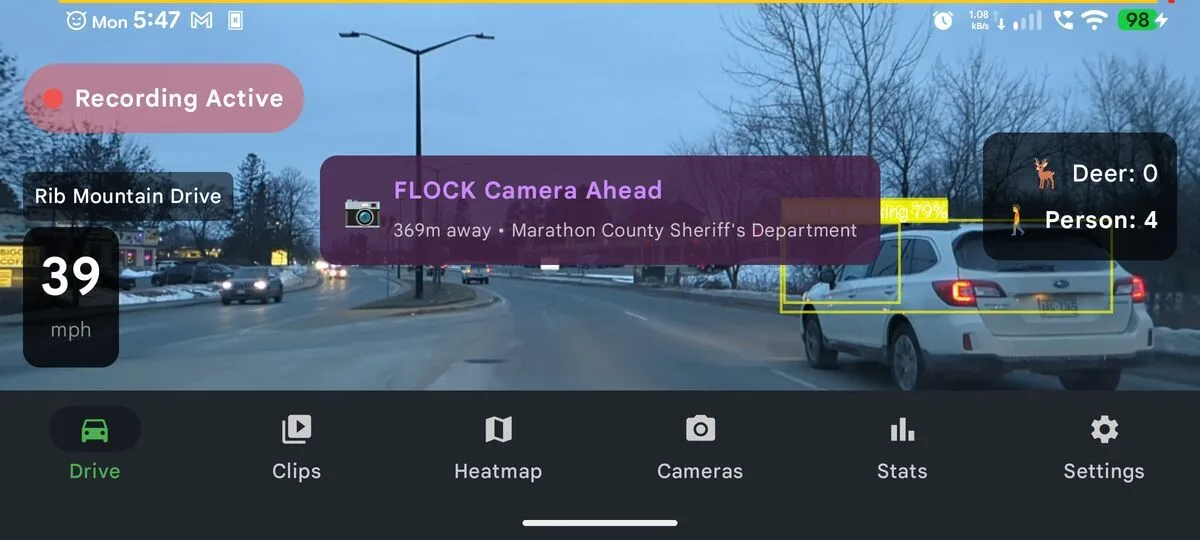
An alert that names what is ahead and how far. Distance is the difference between information and a buzz.
How to test whether a police radar app actually works
You do not have to take anyone's word for it. Five checks, about five minutes.
Turn on airplane mode
This one test settles most of it. A genuine alert app depends on data, so with no connection it should tell you it is offline or fall back to whatever it cached. A fake will cheerfully keep sweeping and “detecting” signals with no connection and no hardware, which tells you the animation was never connected to anything.
Look for a named data source
Open the map or the about screen and look for where the data comes from: public camera records, an ALPR map layer, ADS-B feeds, community reports. An app that never names a source usually does not have one.
Check for distance and direction
A real alert tells you how far ahead the camera is, and ideally which way it faces. A generic beep with nothing attached to it cannot be acted on, and cannot be checked either.
Drive a camera you already know
Pick a fixed speed or red light camera near home and drive past it. A mapped database will warn you in the same spot every single time. If the alert wanders, or fires once and never again, it is guessing.
See whether reports can be corrected
Crowd-sourced maps rot. Look for expiry and a way to flag that something is gone. Without both, you are looking at ghosts within weeks, and false alarms train you to ignore the real ones.
An alert app that names its sources
DriveSight maps 336,000+ speed and red light cameras, ALPR plate readers with their facing direction, community police reports, and law enforcement aircraft over public ADS-B. It also records your drive as a dash cam.
Download DriveSight FreeRed flags of a fake radar app
- It works in airplane mode. Nothing legitimate can.
- It asks for microphone permission to “detect radar”. A microphone cannot hear 24 GHz.
- No data source is named anywhere in the app or the listing.
- Alerts carry no distance, just a buzz or a flashing light.
- Reviews describe constant false alarms, which is the signature of random output.
- The screenshots are all animation and never show a map with real places on it.
What accuracy really depends on
Once you are looking at the alert category, the app's branding matters much less than the data underneath it. There are three tiers, and they are not equally trustworthy.
Fixed cameras are the most reliable, because a camera bolted to a gantry is in the same place tomorrow. A mapped location is right every time, which is why this is the category worth paying attention to first.
Community reports are only as fresh as the last driver who passed that spot. They are genuinely useful on busy roads and thin on quiet ones, and they live or die on expiry and false-report flagging.
Aircraft positions are the most objective of the three, because the aircraft itself broadcasts its identity and position continuously over ADS-B. There is no crowd to trust and nothing to go stale. We covered that layer in detail in the police aircraft tracker write-up.
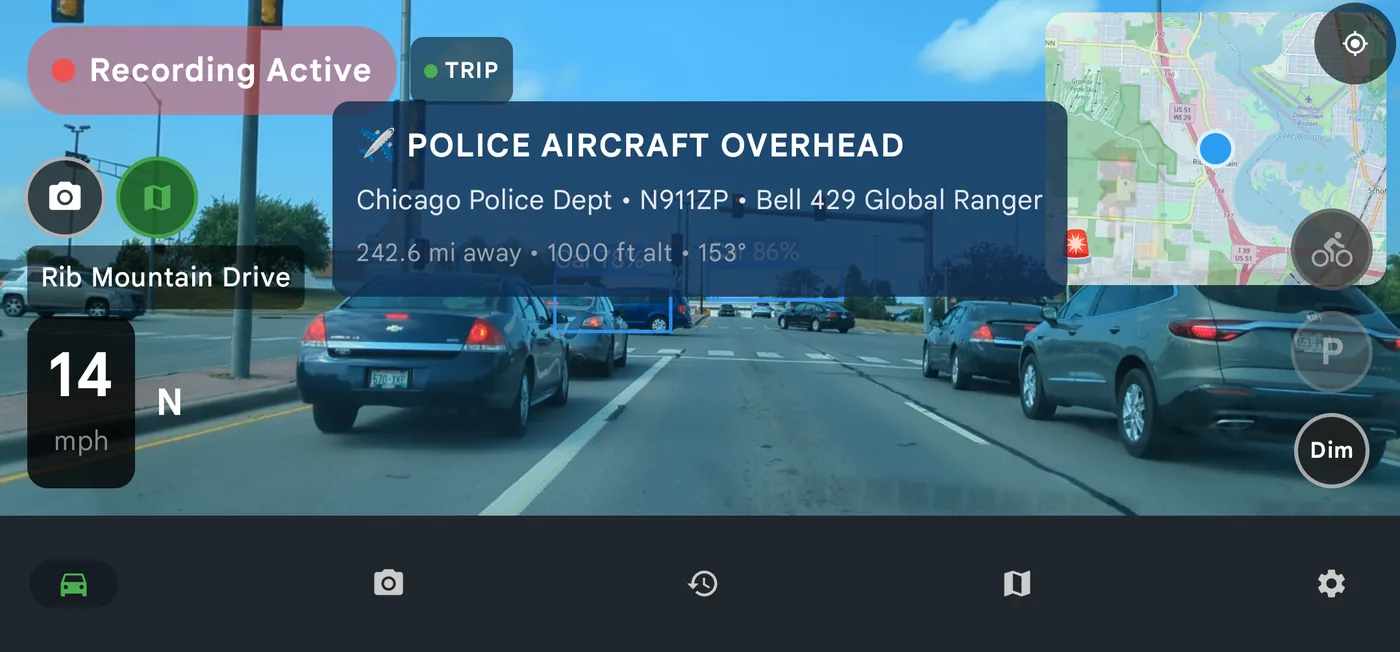
The most verifiable alert of the three: you can look the tail number up in the FAA registry yourself
What to install instead
For the practical side of the category on Android, including which parts are actually free and why alerts sometimes stop firing in your pocket, see police radar detector app for Android.
If what you want is to stop being surprised by enforcement, skip the radar animations entirely and pick something that maps. For the full breakdown of what each approach catches on the road and overhead, see do radar detector apps work. If you would rather compare the specific apps in this space, we ranked them in the best radar detector apps for 2026, and the camera-focused ones in the top speed camera alert apps.
A note on what this is for
Knowing where cameras and patrols are tends to make drivers slow down and stay slow, which is the entire point of enforcement. Use it to drive more carefully where it matters, not to speed between the alerts. The limit applies whether or not anyone is watching.
Frequently Asked Questions
Is there a police radar app that actually works?
Not literally, because no phone can detect radar. What works is the alert category: apps that map fixed cameras and plate readers, carry community reports of patrol cars, and track law enforcement aircraft over public ADS-B. Those warn you before you arrive instead of detecting a beam already aimed at you.
How can I tell if a radar detector app is fake?
Put the phone in airplane mode and open it. A real alert app needs data and will say it is offline. A fake keeps sweeping and detecting with no connection at all. Other giveaways are no named data source, alerts without distance, and no way to report that something has gone.
Do radar gun apps work?
Apps that claim to measure another car's speed through the camera estimate from video rather than measuring a doppler shift, so they are not accurate enough to rely on. They are also unrelated to being warned about enforcement ahead of you.
What is the difference between a police radar app and a police scanner app?
A scanner app streams public safety radio, so you hear dispatch, often delayed and increasingly encrypted. A radar app is supposed to warn you about enforcement near your car. Different problems entirely, though search results mix them constantly.
What is the most accurate police alert app?
It depends on the data, not the branding. Fixed cameras are the most reliable because they never move. Community reports are only as fresh as the last driver through. Aircraft are the most objective, because they broadcast their own position.
Is a police radar app legal?
Alert apps that map public camera locations and carry driver reports are legal across the United States, much like navigation apps showing reported hazards. Radar detector hardware has its own restrictions for commercial vehicles and a couple of jurisdictions, but a mapping app is a different thing. Check local rules on mounting and handling a phone while driving.
Skip the animation. Get alerts with a source behind them.
336,000+ mapped cameras, ALPR readers, community police reports, police aircraft over ADS-B, and a full dash cam, in one free download.
Download DriveSight Free